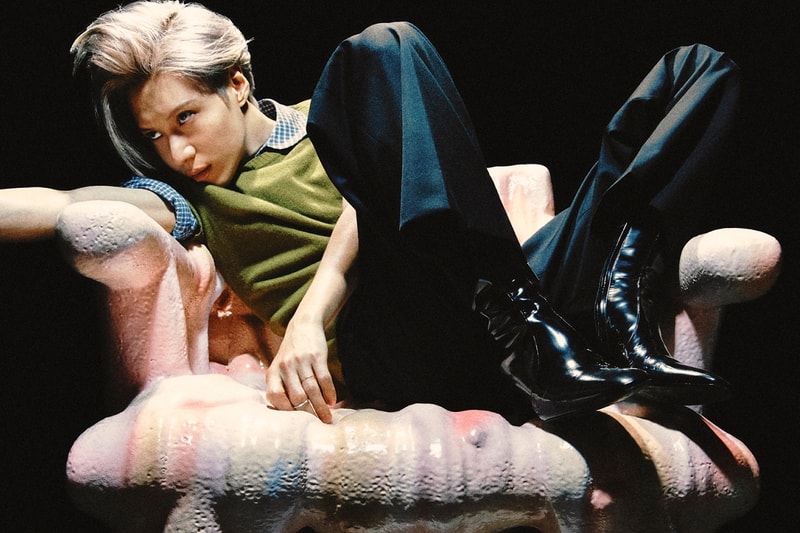
Taemin has spent almost 20 arguing that a pop star can be an unsettling one too, and PHASE 1: Soft Violence is his most literal case for it yet. The album introduces itself with a sugar cube being pulled apart by ants, an image that reads as sweet and grim in the same glance, and from there he fills the record with slime, clay and holes torn through walls. None of it is set dressing. Each object stands in for a version of himself he has lived through and kept.
The title is the whole thesis in two words; the SHINee and SuperM staple treats loveliness and harm as the same material rather than as opposites, which is where the "violence" in the phrase comes from. "I believe there is cruelty within beauty, and in a certain sense, that can also be a form of violence," he says. He applies the same logic to his own history, declining to sort it into wins and wounds. The hard stretches and the joyful ones, in his telling, fed the same foundation, and the injuries that keep surfacing across the album are really the many Taemins who built the one speaking now.


If the album serves an accounting of the past, the tour is written in the present tense. He named it "LiMiNaL" after the threshold — the charged pause that comes before anything actually changes, and he is frank that the choice was a message to himself as much as a concept for an audience. "'LiMiNaL' refers to a boundary or a state of being on the threshold. I chose the title 'LiMiNaL' for this tour because I wanted to take a step beyond the way I had been doing things up until now," he explains. He describes the era as a doorway he is currently standing in, with the next chapter waiting on the far side. "In a way, I think 'LiMiNaL' represents who I am right now, standing at that threshold. And through 'PHASE 2,' which will follow, I want to show a version of myself that has crossed that boundary and taken another step forward."
A lot of that momentum traces back to a field in the California desert. Taemin performed at Coachella billed as the first Korean male soloist to do so, and the size of the moment clearly lodged itself somewhere permanent. "I also realized, 'There's a much bigger market and a much bigger world out there,'" he says. What stayed with him was the way the crowd used the platform, moving and singing together instead of simply watching a performance, and it quietly reset his sense of the job. "In the past, I tended to approach music by focusing primarily on the performance itself. Now, I think more about how the music might feel from the audience's perspective."
A realization like that carries more weight for someone this deep into a career. Nearly two decades in, Taemin has a method that works, which is exactly the thing he now wants to disturb. "So rather than continuing to repeat what I've been doing for all these years, I want to try working on albums in a slightly different way," he says, and he extends the impulse to how he writes, produces and constructs the visual world around a release. He is careful, though, not to sell this as a reinvention. "In a way, I think the boundary I want to cross now isn't about abandoning the things I've done well up until this point. It's about using those experiences as a foundation while allowing myself to explore new ways of doing things."


For an artist this far along, all the talk of thresholds could easily harden into branding. Taemin makes it sound closer to a discipline, a way of moving forward without letting go of what got him here. PHASE 1: Soft Violence lays out the terms. PHASE 2, he promises, is where he walks through.