微信内可能无法直接打开本站。请点右上角 ··· → 在浏览器打开,或复制链接。
Amazon Clothing Share Doubles as Walmart Loses Ground
RSS 官方收录 · 可信分层展示
关键摘要
Amazon’s share of U.S.clothing spending has doubled since 2019 while Walmart’s has edged lower, a six-year divergence that was still widening during the first half of 2026.…
- PYMNTS Intelligence estimates that Amazon accounted for 17.
- clothing spending in 2025, compared with 8.
- Walmart moved from 7.
摘要引擎:抽取
正文提要
Amazon’s share of U.S. clothing spending has doubled since 2019 while Walmart’s has edged lower, a six-year divergence that was still widening during the first half of 2026.
PYMNTS Intelligence estimates that Amazon accounted for 17.0% of U.S. clothing spending in 2025, compared with 8.5% in 2019. Walmart moved from 7.3% to 6.2% over the same period. The figures in the PYMNTS analysis measure company clothing revenue against U.S. clothing category retail sales using Census Bureau data.
That produced a much different competitive picture from the one that existed before the pandemic. Amazon’s estimated clothing revenue rose from $38.7 billion in 2019 to $109.4 billion in 2025, while Walmart went from $33.5 billion to $39.1 billion. Amazon’s clothing sales were 1.15 times Walmart’s in 2019 and 2.8 times Walmart’s by 2025.
The gap kept growing this year. Amazon’s estimated clothing revenue increased 14.7% year over year to $55.5 billion in the first half of 2026. Walmart was essentially unchanged at $19.4 billion.
The quarterly pattern is similar. Amazon generated an estimated $29.8 billion in clothing revenue in Q2 2026 versus about $10.1 billion for Walmart, producing a $19.7 billion difference. A year earlier, the gap was $15.3 billion.
Holiday quarters have opened the spread further. The difference reached $22.5 billion in Q4 2024 and $23.9 billion in Q4 2025, the two largest gaps in the eight quarters covered by the PYMNTS analysis.
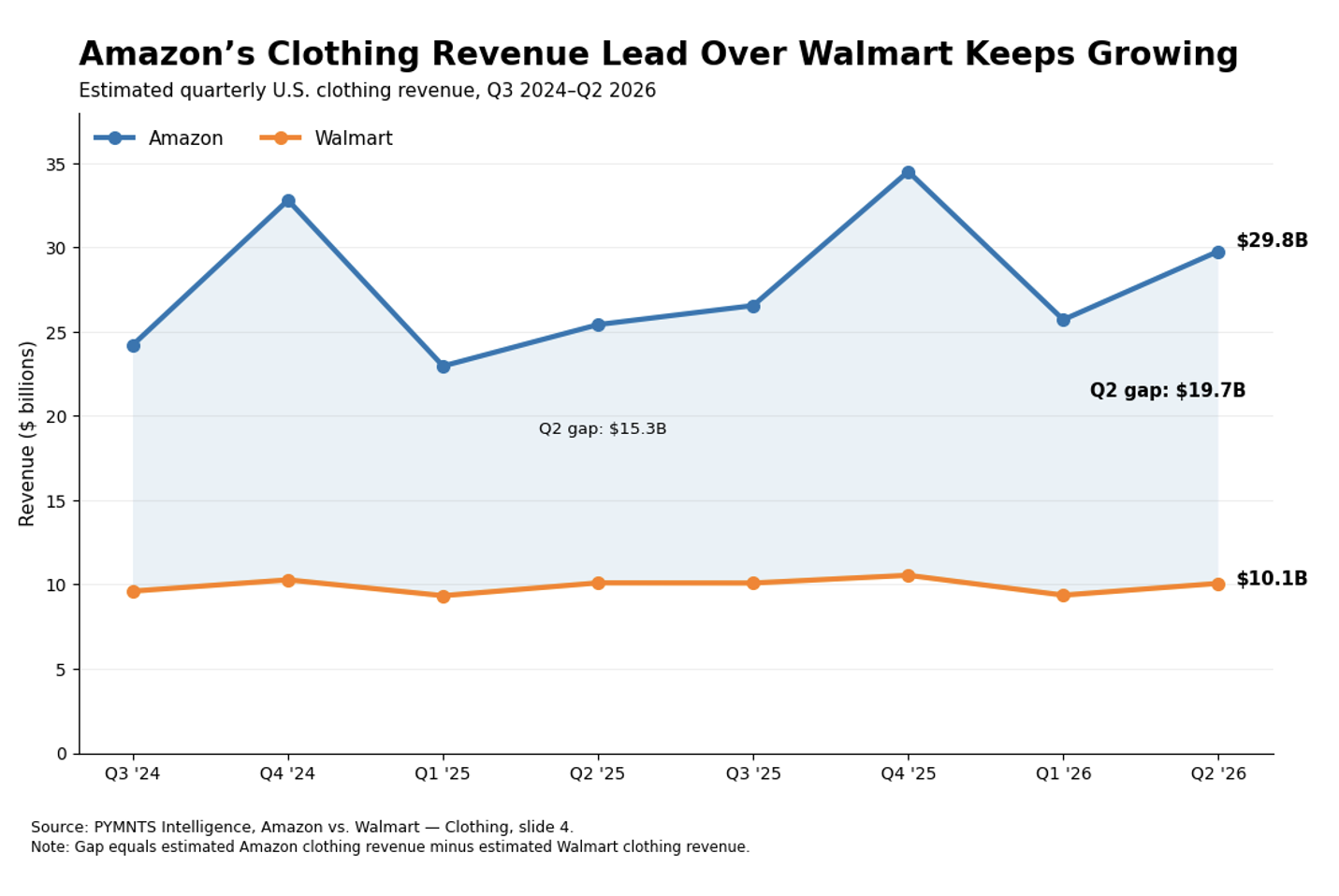
Amazon’s holiday lift has also become much larger relative to Walmart’s. From Q3 to Q4, Amazon’s clothing revenue rose roughly 30% in 2025. Walmart’s increased 4.5%. In 2020, Amazon’s Q3-to-Q4 increase was 2.3 times Walmart’s. By 2025, it was 6.7 times as large.
Walmart’s Fashion Growth Hasn’t Closed the Gap
Walmart’s latest earnings call points to stronger results in parts of its clothing business, although management didn’t report an overall apparel growth rate.
Walmart U.S. CEO David Guggina said the retailer was seeing strength in fashion and specifically said Scoop and Free Assembly were posting triple-digit comparable-sales growth.
CFO John David Rainey also said Walmart was carrying more elevated and higher-priced merchandise aimed at a broader range of shoppers. He linked some of Walmart’s gains among higher-income customers to its assortment.
Those comments show growth in particular brands and merchandise ranges. They don’t establish that Walmart’s overall clothing business is growing at anything close to those rates. The PYMNTS data point the other way at the category level: Walmart’s estimated clothing revenue was flat in the first half of 2026.
The market-share data reinforce the distinction. PYMNTS Intelligence’s latest 2026 reading puts Amazon at 17.8% of U.S. clothing spending, up from 15.7% in 2024. Walmart is at 6.0%, down from 6.5%.
PYMNTS Intelligence calculates each retailer’s clothing or apparel sales as a percentage of U.S. Census clothing-category retail sales for the same period.
Macy’s provides another measure of how concentrated the category has become around Amazon. Its latest estimated share is 3.1%, compared with 3.4% in 2024. The latest Macy’s reading is based on Q1 2026 because the company hadn’t yet reported Q2 when the PYMNTS analysis was prepared.
Online Spending Changes the Route to the Sale
The clothing numbers also sit inside a broader retail trend: Americans continue to move a larger share of purchases online.
U.S. retail eCommerce sales increased 12.2% year over year in Q2 2026, while total retail sales increased 6.7%, according to the Census Bureau. Online commerce accounted for 17.1% of total retail sales, up from 16.3% in Q2 2025.
Those figures cover retail broadly. They don’t show that clothing spending specifically moved online, and they can’t be used to attribute Amazon’s clothing-share gains to eCommerce.
They do establish that online retail continues to grow substantially faster than retail overall. That creates a relevant backdrop for a clothing category in which Amazon has been gaining share.
Walmart’s own results show that it’s participating strongly in that online growth. Walmart U.S. eCommerce sales increased 24% in its latest quarter, including roughly 43% growth in store-fulfilled delivery. Marketplace sales grew 52%.
Walmart also said fast-delivery orders can contain fashion alongside grocery, pharmacy and other merchandise. That gives the company another way to put clothing into transactions that may have originated with a different shopping need.
But the PYMNTS numbers show that rapid growth in Walmart’s overall eCommerce operation hasn’t yet translated into clothing-share gains. Its estimated share has slipped while Amazon’s has risen.
Amazon’s earnings presentation doesn’t provide an apparel breakout, so its reported North American sales growth can’t be used as evidence of clothing growth. The clothing figures here come from the PYMNTS Intelligence analysis rather than an Amazon-reported apparel segment.
The clearest trend is therefore the simplest one. Amazon and Walmart were relatively close in clothing in 2019. Since then, Amazon has more than doubled its share, Walmart has given up share, and the gap has continued to widen into 2026. Walmart is getting growth from some fashion brands and its digital business is expanding quickly, but neither has yet changed the direction of the broader clothing numbers.
The post Amazon Clothing Share Doubles as Walmart Loses Ground appeared first on PYMNTS.com.