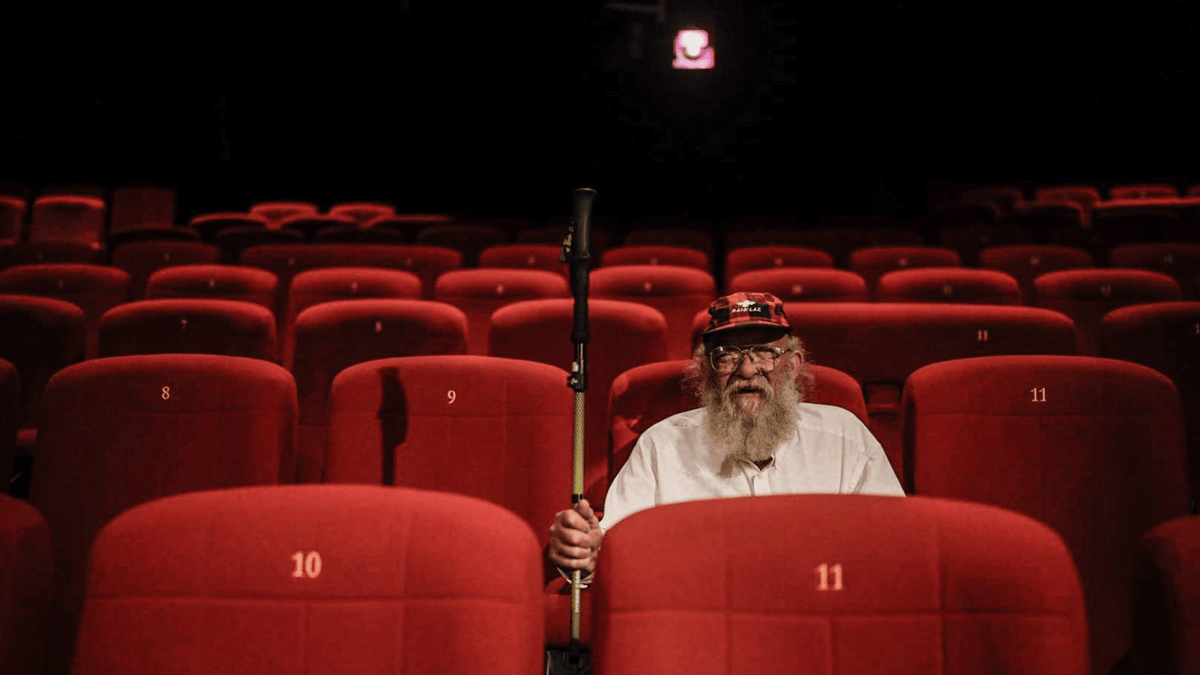
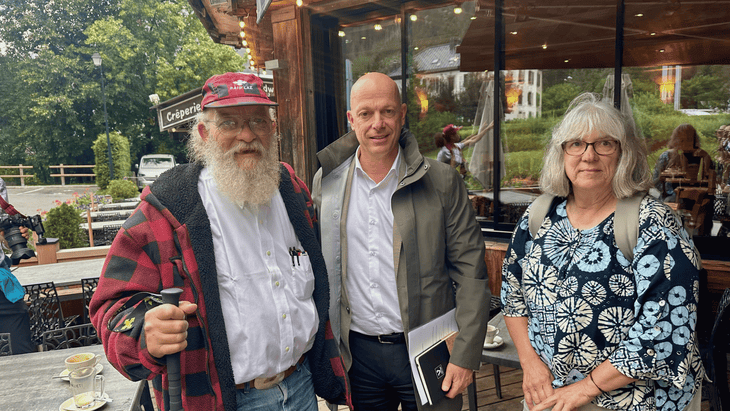
In what might have been the most surreal moment during the otherwise wild—if not borderline chaotic—week of trail running hoopla during UTMB Week in Chamonix, was a quiet and curious conversation between Chamonix mayor François-Xavier Laffin and Gary Cantrell on Friday morning at Restaurants Les 2 Gares.
Yes, that Gary Cantrell, otherwise known as “Lazarus Lake” or simply “Laz” to anyone who laces up trail running shoes and engages in zany Type 2 fun.
Before you ask what in the wide world of backyard ultra hallucinations would have brought these odd fellows together, let me set the scene.
One was wearing a tweed sportcoat, a crisp white button-down shirt, black business slacks, shiny black leather dress shoes and what looked like a London Fog rain jacket. The other was also wearing a crisp white button-down shirt, but paired with faded Levi’s blue jeans, a pair of black and white Brooks Ghost 18 road running shoes, a hearty black and red checkered buffalo plaid fleece jacket, and a matching running cap that says, “Raid Laz” on it.
The hat was a gift from the French trail running brand Raid Light, which sponsored the premier of “The Hillbilly Scientist” documentary about Cantrell the night before in Chamonix. The cap didn’t quite contain Cantrell’s scraggly gray lettuce that escapes out of the back, matching the untamed vibe of his robust gray beard that, combined with a sardonic wit and an ever-present Camel cigarette, have become the calling card for some of the most creatively outlandish trail running races the world has ever known.
In contrast, Mayor Laffin is not only clean-shaven, but also entirely bald, giving off the fastidious hairless vibe of a middle-aged man who knows how to get things done. And given the pressure of his constituency to tone down the madness of UTMB, he’s a man who has to get things done.
Ultimately what has brought these odd fellows together for coffee is a sincere discussion about how to put on compelling trail running races in stunning places without drawing 100,000 spectators, fans and hangers-on into town.
Only it doesn’t turn out to be a chat over coffee, because only the mayor orders a coffee. Cantrell had drained a 16-ounce Monster Energy drink while walking to the meetup with his wife, Sandra, and his singular trekking pole. He declined the waiter’s inquiry for a latte, cappuccino, or anything resembling a cup of joe.
Tour de Chamonix
Once seated at the restaurant, the mayor explains what has already become wildly apparent around town. He’s been tasked by a decree of the voters who elected him with reducing the mayhem and noise that surrounds the Ultra-Trail du Mont-Blanc festival of trail running races that arrives every August to this bigger-than-life mountain village that is quite obviously already overblown with summer tourism.
It’s not that the 9,000 or so full-time residents are against trail running or tourism, he says. It’s more that the ever-growing set of races (UTMB started as the original 108-mile loop around the Mont Blanc massif in 2003 and has expanded to eight races spread throughout the week) and all of the adjacent commotion of fun runs, brand activations, film premiers, parties, and personal time trials up the VK route have gotten to be a bit much.
“There are a lot of people here,” Cantrell says with a laugh. “But where I live, in a normal week, I see more deer than people.”
Ultimately, the congestion is only part of the problem, but ultimately it’s the impact to the local environment that is already under duress. The glaciers of the Mont Blanc massif high above this meeting of the minds are melting faster than ever before and natural resources are being strained.
In the 30 or so minutes the mayor’s team has set aside for this meeting, Cantrell also indulges Laffin bits about the Barkley Marathons, the creation of backyard-style ultra races, and Cantrell’s most recent transcontinental walk across the U.S.
The thread that runs through each are uniquely challenging experiences for runners that create transcendent moments. But if there is a thread that connects these two men is that they both deeply care about the environments in which they live.
Cantrell says he sees both sides, though.
“It’s not a race I would put on,” he says about UTMB. “But I’ve heard from many runners that it’s a dream of theirs to visit Chamonix and run UTMB. And that’s saying something and at least one reason for doing it. But there are responsibilities that go with it, and it just comes down to how you manage it.”
Mayor Laffin seems genuinely interested in what Cantrell is saying, but he’s on a busy schedule and twice his phone rings—to the James Bond theme song—forcing him to pause the conversation with Cantrell. The conversation wraps without definitive takeaways but a mutual understanding that changes must be made.
It’s time for the mayor to get on with his day and time for the Cantrells to board the Train du Montenvers, a historic red cog railway that climbs nearly 3,000 vertical feet from Chamonix to the edge of the Mer de Glace glacier.
The iconic, fast-melting glacier has become the focal point of the perceived strain UTMB has put on the Chamoninx-Mont Blanc region.
“You’ve got to take care of it,” Sandra offers. “Like Frozenhead. The reason Gary does the Barkely the way he does with no one around is so you can preserve it. With all these people, it can be destructive.”
‘Everything is Out of Sync’
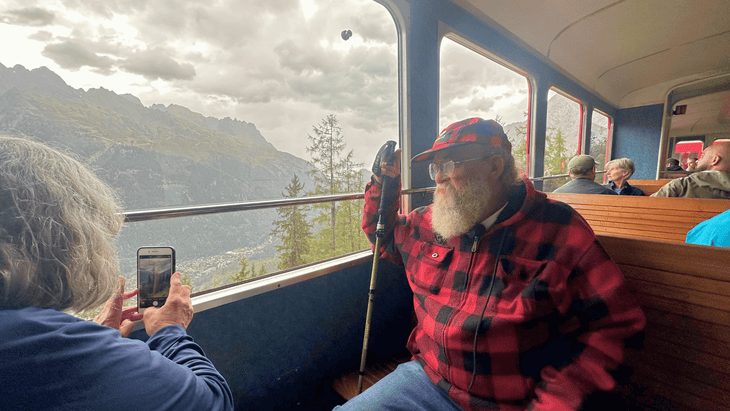
As the train departs the station, Cantrell is admittedly nervous about the trip but seems to settle in as he tells a story about a long ago train ride in which he had to time his smoking breaks between stops on the platform of depots before hearing the conductor yell “All Aboard!” and hopping back on the train.
On the way up the grade, the train’s general manager regales Cantrell with details about the historic train—that construction began in 1895, that it has a cog wheel gearing system that allows it to easily climb up a 24 percent grade, and that the train engineers are required to do 150 hours of training.
He goes on to say that Napoleon’s first wife, Empress Joséphine, emotionally distraught from a divorce from the French emperor, visited Chamonix in 1810 seeking peace and self-discovery. She was one of the first to bring attention to Mer de Glace on a famous trek that included a crew of 60 people and eight donkeys. Widely reported in French newspapers at the time, she ultimately slept adjacent to where the glacier used to exist and where the train now stops.
“The train used to go to the edge of the ice of the glacier,” he says, showing Cantrell early 1900s images on his phone of the train adjacent to the glacier. “It’s terrible. It’s the place in the world where you really can see the degradation of the glaciers.”
Cantrell isn’t surprised to hear about how the glacier has melted and receded faster than ever since the early 1990s. He offers that he has seen plenty of evidence of a changing planet during the same time frame around his home in Bell Buckle, Tennessee. He laments that in recent years the town’s annual daffodil festival in late March has happened after the daffodils have already bloomed and wilted.
“Everything is out of sync,” Cantrell says. “With all of the migratory animals, everything was timed. They arrived when the food was ready. Now the food is there a month before they get there. In the forest, the leaves used to change colors, some based on the temperature, some based on the sun. Now our leaf season is split into two pieces. You don’t get all of the leaves changing at once anymore. So many things have changed.”
Immediately after getting off the train, Cantrell is spotted by a group of French trail runners passing by the train depot during a mountain run. They’re mystified by his presence and shake his hand, then request Cantrell has a smoke with them. Cantrell acquiesces, already reaching for his pack of Camels in his shirt pocket.
“I just wanted to make sure I was in a place where they allowed it,” Cantrell says. “That was a cigarette-worthy ride.”
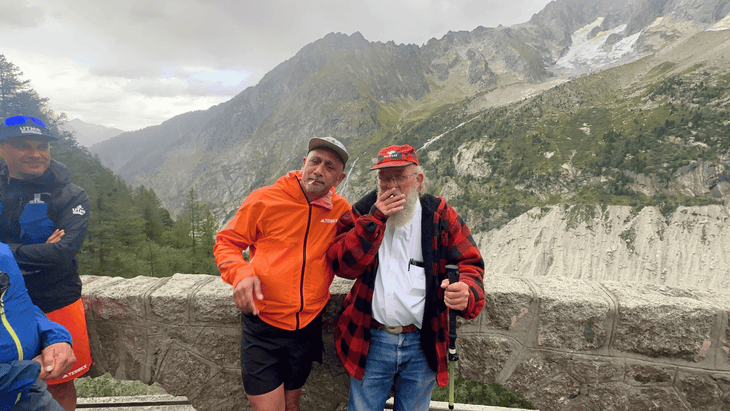
Several of the runners thank Cantrell for the events he has created and the quirky culture he has helped propagate. Others line up for selfies, and a few not-so-sheepishly ask what’s the secret they need to know to get into next year’s Barkley.
There is no secret, Cantrell says. “You have to apply on the day the application is open,” he says. “Then you have to have really bad luck at drawings.”
While Cantrell understands he is a recognizable figure, he is truly amazed at his own popularity. But he has never done it for his own notoriety.
“It’s strange,” Cantrell said. “My philosophy as a race director is ‘your job is to provide a venue for runners to find greatness in themselves,’ and the races succeed the most if you remember that it’s not about you. You expect not to be recognized.”
As the runners depart, Cantrell and his wife are led inside a small cafe, where fresh, warm chocolate croissants are delivered and devoured.
“It’s always nice to get a pastry when it’s still warm.” Cantrell says. “You need to have the American treat, chocolate chip cookies, right out of the oven when they’re warm. When we make chocolate chip cookies, they’re never around long enough to get cold.”
After that, Cantrell wanders outside, digs out his pack of Camels, and pulls out another smoke. He says he had his relief from the post-train cigarette, now it’s time for the post-meal cigarette.
Did he ever consider quitting?
“My parents didn’t raise a quitter,” he says. “If you start something, you have to finish it.”
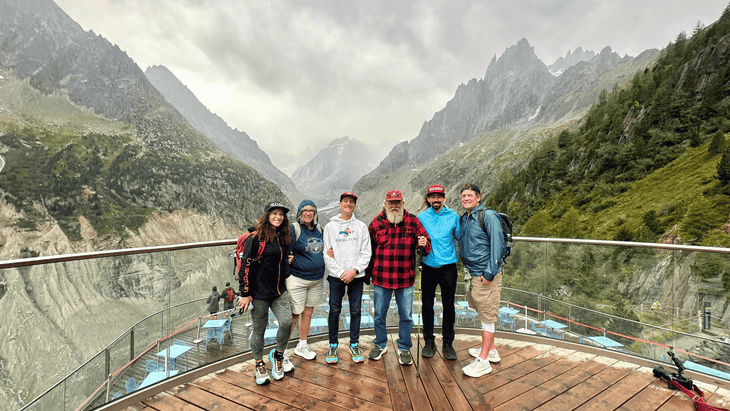
The small group of people the Cantrells are with listens to a glaciologist talk about the shrinking Mer de Glace glacier behind them, lamenting that less snow and warmer temperatures over the past 35 years has sped up the rate of melting and that predictions suggest that 98% of the glacier will be gone by the end of the 21st century.
Looking over the edge, Cantrell marvels at a small section of blue ice that can be seen in a massive split in the otherwise debris-covered glacier at the bottom of the valley. He pauses for a moment and digs into his youth for a memory that seems to relate directly to what he’s seeing.
“If you make a snowman when the ground is warm and the snow is on top, it picks up dirt and then melts really fast,” Cantrell says. “If the ground was frozen when it snowed and you make a snowman, the snowman is white and it lasts for a long time.”
A Man of the People
Back in town later that day, Cantrell sat at the Raid Light booth of the UTMB race expo for two hours and greeted runners and fans from around the world, many stunned and overjoyed to see him. He signed books, photos, movie placards and Raid Light hats and posed for selfies. (He mostly signed as “LAZ,” but admitted that when he could learn a bit about the person he could offer a more personal message.)
“It was very unexpected to see him here,” says a runner from South Korea. “Barkley is one of the races I have always wanted to run. I don’t know if I could finish, but it’s been something I have wanted to do since I saw the movie, The Race That Eats Its Young.”
While Cantrell might seem out of place in France, he has been warmly welcomed by French trail runners for nearly a decade.
He helped a running group near Grenoble start the Barkley-inspired Chartreuse Terminorum, which came to life after Benoît Laval’s four failed attempts at Cantrell’s famous event at Frozen Head State Park. The Chartreuse Terminorium is a dastardly 300-kilometer race with 82,000 feet of vertical gain and loss in which runners need to pull pages from hidden books that Cantrell helped event organizers place in the inaugural year in 2017.
And see if this sounds familiar: More than 300 people apply every year, and only about 40 are accepted. Plus, only six have ever finished: five in 2023 and one in 2024.

Cantrell also visited France to ring the bell that inaugurated Backyard Toulouse, a backyard ultramarathon in Castanet-Tolosan, in January 2025.
“When I met him the first time, it was impressive,” says Nicolas Diederichs, the communications manager at Raidlight, co-organiser of the Chartreuse Terminorum, and founder of the first backyard ultra in France. “But when I met him, I met Lazarus Lake. And now I know Gary Cantrell. It’s two different people but one special individual.”
By now the mayor is long gone. But it’s in this frenzied periphery of trail running’s biggest stage, one UTMB officials have fought tooth and nail to keep at the top, that Cantrell offers, perhaps, an ethos for the future here.
Although he’s been putting on some of the world’s most captivating races for 40 to 45 years, Cantrell has never set out to build world-dominating events or develop a lasting legacy for himself. He’s in it for the love of the game and doing it for the runners, but he knows one day it will come to an end.
“If I had been the athlete I wanted to be, my career would have been over 50 years ago,” Cantrell says. “But now, as a race director, it’s been such a joy. I know it can’t go on forever, but I have had so much pleasure to be a part of the sport and to have a role in all of the great things that have been done over so many years. I have had great, good fortune.”